
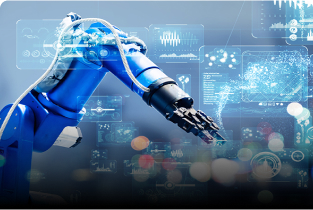
In today’s technology-driven world, embedded systems, the Internet of Things (IoT), and robotics are among the most transformative fields shaping industries such as healthcare, manufacturing, transportation, agriculture, and smart homes. Although each discipline may seem distinct, they are deeply interconnected—often working together to create intelligent, autonomous, and highly efficient systems.
This blog explores how these three domains relate, overlap, and empower each other.
1. Understanding the Three Technologies
Embedded Systems
An embedded system is a specialized computer designed to perform dedicated functions within a larger system. Examples include:
-
Microcontroller-based devices
-
Digital watches
-
Home appliances
-
Automotive ECU systems
They combine hardware (processors, sensors, actuators) and software (firmware), making them essential for controlling real-world operations.
Internet of Things (IoT)
IoT refers to a network of devices connected through the internet, capable of sensing, collecting, and exchanging data. Examples include:
-
Smart thermostats
-
Fitness trackers
-
Industrial sensors
-
Connected vehicles
IoT adds connectivity and intelligence to everyday and industrial devices.
Robotics
Robotics involves designing machines capable of performing tasks autonomously or semi-autonomously. Robots typically include:
-
Sensors for perception
-
Actuators for movement
-
Controllers for decision-making
-
Software for performing tasks
They can range from simple robotic arms to advanced humanoid robots.
2. How Embedded Systems, IoT, and Robotics Work Together
A. Embedded Systems: The Foundation of Both IoT and Robotics
At the heart of both IoT devices and robotic systems lies an embedded controller.
-
In IoT devices, microcontrollers collect sensor data and send it to cloud or edge servers.
-
In robots, embedded processors handle motor control, sensor fusion, and real-time decision-making.
Without embedded systems, neither IoT nor robotics would function effectively.
B. IoT Enhances Robotics Through Connectivity
Robotics becomes smarter and more efficient with IoT integration.
Examples:
-
Cloud robotics: Robots use cloud computing for heavy data processing.
-
Remote monitoring: IoT sensors help track robot performance, maintenance needs, and energy usage.
-
Swarm robotics: Multiple robots communicate over networks to complete tasks collaboratively.
IoT allows robots to stay connected, updated, and remotely controlled.
C. Embedded Systems Make IoT Devices Intelligent and Autonomous
IoT devices rely on embedded systems for:
-
Data collection from sensors
-
Real-time processing
-
Executing automated responses
-
Energy-efficient operations
This blend allows IoT devices to operate independently even without internet, using edge computing.
D. Robotics Uses IoT Data for Smarter Decision-Making
Robots often depend on IoT-generated data for:
-
Navigation (GPS-based systems)
-
Environmental monitoring (temperature, humidity, obstacles)
-
Industrial automation (machine status, workforce coordination)
IoT expands the robot’s awareness of its environment by providing continuous, real-time data.
E. Industrial Automation: The Largest Area Where All Three Converge
In Industry 4.0, all three technologies merge seamlessly.
For example:
-
Embedded systems control machines on the factory floor.
-
IoT connects machines, sensors, and robots to a central network.
-
Robots perform tasks like pick-and-place, packaging, welding, and quality checks.
Together, they enable:
-
Predictive maintenance
-
Autonomous manufacturing
-
Real-time decision-making
-
Improved efficiency and safety
3. Real-World Examples of Their Interconnection
1. Smart Agriculture
-
Embedded systems control irrigation pumps.
-
IoT sensors monitor soil moisture and weather data.
-
Robots perform tasks like seeding, spraying, and harvesting.
2. Healthcare
-
IoT wearables track health metrics.
-
Embedded systems manage life-support devices.
-
Robots assist in surgeries, patient care, and rehabilitation.
3. Home Automation
-
IoT devices manage lighting, security, and appliances.
-
Embedded systems enable automation.
-
Robotics includes robot vacuums and smart assistants.
4. Autonomous Vehicles
-
Embedded systems control sensors, braking, and navigation.
-
IoT enables vehicle-to-vehicle communication.
-
Robotics handles self-driving functions and decision-making.
4. Future Trends Driven by Their Convergence
-
Edge AI: More intelligence inside embedded devices and robots.
-
5G-powered IoT: Real-time data exchange at high speed.
-
Collaborative robots (cobots) working with humans.
-
AI-powered IoT (AIoT) merging artificial intelligence with IoT infrastructure.
-
Smart cities fully integrating IoT, robotics, and embedded systems.
The overlap will continue to grow as industries demand smarter, safer, and more autonomous solutions.
Conclusion
Embedded systems, IoT, and robotics are deeply interconnected technologies that complement and empower one another. Embedded systems act as the backbone, IoT provides connectivity and data exchange, and robotics adds physical action and autonomy. Together, they form the foundation of the intelligent systems that are transforming industries and everyday life.


