
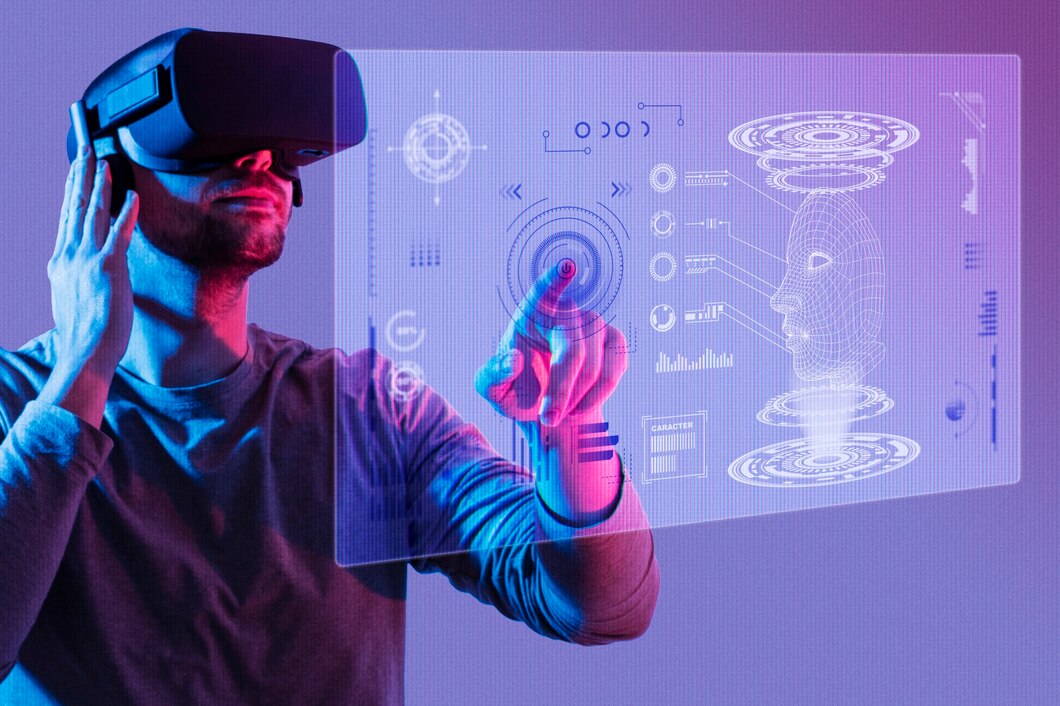
Augmented Reality (AR), Virtual Reality (VR), and Mixed Reality (MR) are transforming how we interact with digital content. From immersive gaming to advanced medical training, these technologies are rapidly expanding across industries. But a common question many learners and tech enthusiasts ask is: Are AR, VR, or MR actually part of Artificial Intelligence (AI)?
The short answer is: They are not the same as AI—but they often work hand-in-hand.
To understand this better, let’s break it down.
What Are AR, VR, and Mixed Reality?
Augmented Reality (AR)
AR overlays digital elements—such as text, images, or 3D models—onto the real world.
Examples: Pokémon Go, Snapchat filters, Ikea furniture placement apps.
Virtual Reality (VR)
VR creates a completely digital environment that replaces the real world.
Examples: Meta Quest headsets, VR racing simulators, VR-based education apps.
Mixed Reality (MR)
MR blends AR and VR. You interact with digital elements as if they existed in the physical world.
Examples: Microsoft HoloLens, advanced industrial simulation tools.
None of these technologies require AI to exist, but they become far more powerful when combined with AI.
Is AR/VR/MR Part of Artificial Intelligence?
No, AR/VR/MR are separate technologies.
They come under the domain of extended reality (XR), which focuses on immersive experiences, visuals, sensors, motion tracking, and human–computer interaction.
However, AI enhances AR, VR, and MR in many ways.
Think of AR/VR/MR as the visual and experiential layer, while AI is the brain that makes these experiences smarter.
How AI Enhances AR, VR, and Mixed Reality
1. Computer Vision
AI recognizes faces, objects, gestures, and environments.
Examples:
-
AR filters detecting your facial expressions
-
MR apps mapping your room automatically
-
AR apps detecting surfaces to place virtual objects
2. Natural Language Processing (NLP)
This allows users to interact with AR/VR systems using voice commands.
Example: VR assistants responding to spoken instructions.
3. Motion Tracking and Predictive Algorithms
AI predicts user movements to reduce motion sickness and make simulations smoother.
4. Content Personalization
AI can recommend:
-
VR educational content based on learning patterns
-
AR shopping items based on user preferences
5. Realistic Simulations
AI makes virtual worlds behave more like the real world.
Examples:
-
Smart NPCs (non-player characters) in VR games
-
AI-generated 3D environments
-
Training simulators that adapt to user performance
Real-World Examples of AI + AR/VR/MR
Healthcare
-
AR-assisted surgery where AI identifies organs or tissues
-
VR therapy sessions powered by AI behavioral analysis
Retail
-
AI-driven AR mirrors that recommend outfits
-
Virtual showrooms adapting to customer taste
Education
-
AI tutors inside VR classrooms
-
MR-based science experiments that adjust difficulty automatically
Manufacturing
-
MR headsets showing real-time AI predictions for machine performance
Why People Think AR/VR/MR Are Part of AI
The confusion often comes from how closely they work together. Many modern XR applications depend heavily on AI for tracking, interaction, personalization, and automation. As a result, it seems like all these technologies belong to “AI,” but technically, they don’t.
So, What’s the Conclusion?
-
AR, VR, and MR are not part of AI. They belong to immersive technology under the broader category of Extended Reality (XR).
-
AI is separate but complementary.
-
When combined, they create intelligent, immersive experiences used in gaming, business, education, healthcare, and more.


