
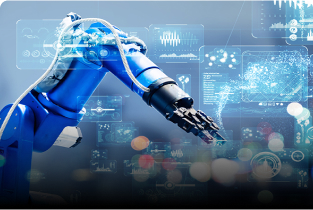
Technology today is all about smartness, efficiency, and automation. Three fields that drive these advancements are embedded systems, the Internet of Things (IoT), and robotics. While they are distinct in focus, they are deeply interconnected and often overlap in real-world applications. Let’s break down how these technologies work together and why they are shaping the future of innovation.
1. Understanding the Basics
-
Embedded Systems
An embedded system is a specialized computing unit designed to perform dedicated functions within a larger system. Examples include microcontrollers in washing machines, sensors in cars, or chips in medical devices. -
Internet of Things (IoT)
IoT refers to the network of devices connected to the internet, collecting and exchanging data. From smart homes to industrial automation, IoT enables devices to communicate and make intelligent decisions. -
Robotics
Robotics involves the design and creation of machines that can perform tasks, often autonomously or semi-autonomously. Robots rely on hardware, sensors, actuators, and intelligent software to operate.
2. The Role of Embedded Systems in IoT and Robotics
At the core of both IoT devices and robots are embedded systems. They serve as the “brains,” processing input from sensors and controlling actuators. For example:
-
In IoT, an embedded system in a smart thermostat collects temperature data and adjusts heating accordingly.
-
In robotics, embedded processors interpret sensor data (like vision or touch) and direct the robot’s movements.
Without embedded systems, neither IoT devices nor robots could function effectively.
3. IoT as the Connecting Network
IoT extends the capabilities of both embedded systems and robotics by enabling connectivity:
-
Robots can be connected through IoT to share performance data, receive updates, or even collaborate remotely.
-
Embedded IoT devices can transmit real-time data to the cloud for analysis, predictive maintenance, or decision-making.
For example, in smart factories, robots powered by embedded systems perform tasks while IoT networks track efficiency, detect faults, and optimize workflows.
4. Robotics Enhanced by IoT and Embedded Systems
When IoT and embedded systems combine with robotics, the results are groundbreaking:
-
Autonomous Vehicles – Cars with embedded controllers, IoT sensors, and robotics capabilities enable self-driving technology.
-
Healthcare Robots – Robots with IoT connectivity monitor patients remotely and use embedded systems for precise movements.
-
Agricultural Robots – Equipped with IoT sensors and embedded controls, these robots optimize irrigation, detect crop health, and harvest efficiently.
5. Real-World Example: Smart Manufacturing
In Industry 4.0, the interconnectedness of embedded systems, IoT, and robotics shines:
-
Embedded systems run sensors in machines.
-
IoT networks collect and share machine data.
-
Robots use this information to adjust production processes in real time.
This integration leads to greater efficiency, lower costs, and smarter automation.
6. The Future of Their Interconnection
The boundaries between embedded systems, IoT, and robotics are becoming increasingly blurred. Together, they are powering:
-
Smart cities with autonomous transport and IoT-driven infrastructure.
-
Advanced healthcare with robotic surgery and IoT-enabled patient monitoring.
-
Space exploration with intelligent, networked robotic systems.
As technologies like AI and 5G evolve, the synergy among these fields will only grow stronger.
Final Thoughts
Embedded systems, IoT, and robotics are not isolated domains. Instead, they form a triangle of innovation, where embedded systems act as the core, IoT provides the connectivity, and robotics represents the practical, physical application. Their interconnection is transforming industries and redefining how humans and machines interact with the world.


