
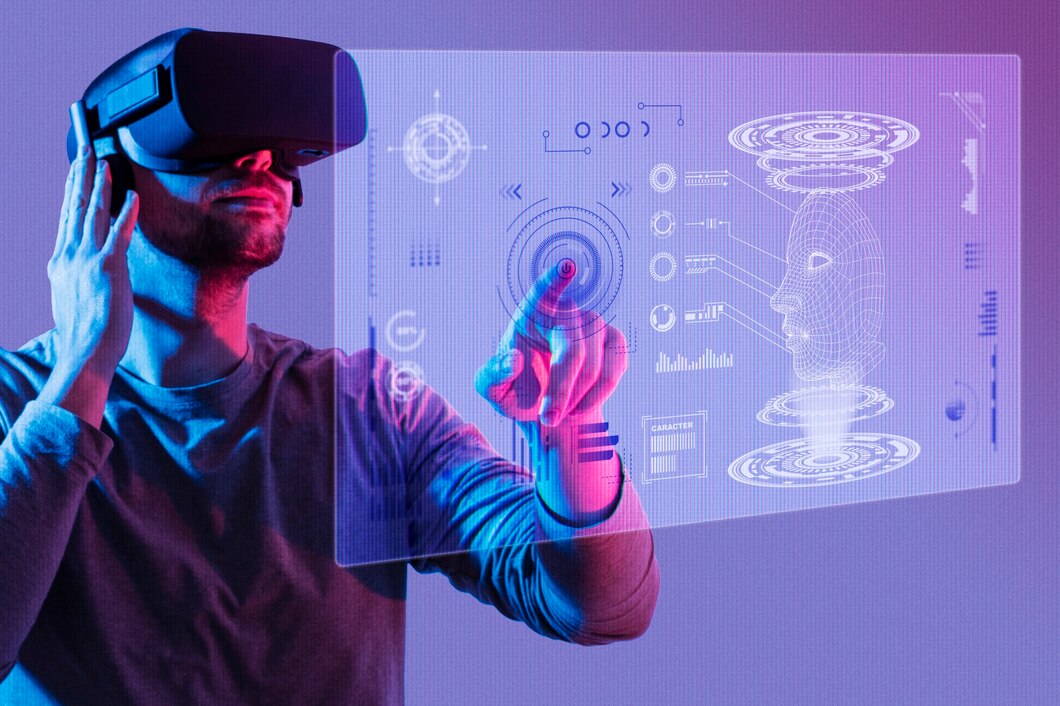
Augmented Reality (AR) and Virtual Reality (VR) are two rapidly evolving technologies transforming industries like gaming, education, healthcare, retail, and entertainment. Though they’re often mentioned together, AR and VR serve very different purposes and create distinct types of digital experiences.
If you’ve ever wondered what sets AR apart from VR, this blog breaks it down in a simple and engaging way.
1. What Is Augmented Reality (AR)?
Augmented Reality overlays digital elements — such as images, text, or 3D objects — onto the real world.
You still see your physical surroundings, but with extra digital information layered on top.
Common examples of AR:
-
Pokémon Go
-
Snapchat & Instagram filters
-
Google Maps Live View
-
IKEA furniture placement app
-
AR-based education apps
Where AR is used:
-
Retail (virtual try-ons)
-
Education and training
-
Navigation
-
Real estate previews
-
Industrial maintenance
2. What Is Virtual Reality (VR)?
Virtual Reality creates a completely immersive digital environment that replaces the real world.
Users enter a fully simulated space using VR headsets and controllers.
Common examples of VR:
-
Oculus/Meta Quest gaming
-
VR-based fitness workouts
-
Virtual travel and tourism
-
VR classrooms and simulations
Where VR is used:
-
Gaming and entertainment
-
Training simulations (military, medical, aerospace)
-
Therapy and mental health
-
Architecture and 3D modeling
3. Key Differences Between AR and VR
Here’s a simple comparison:
| Feature | Augmented Reality (AR) | Virtual Reality (VR) |
|---|---|---|
| Experience Type | Enhances the real world | Replaces the real world |
| Environment | Real-world environment with digital overlays | Fully digital environment |
| Equipment | Smartphones, tablets, or AR glasses | VR headsets and controllers |
| Immersion Level | Low to moderate | High, fully immersive |
| User Interaction | Interact with both real and virtual elements | Interact only with virtual elements |
| Mobility | High — users can move freely in real environments | Limited to VR space; often stationary |
| Cost | Generally lower | Higher due to specialized devices |
| Use Cases | Retail, navigation, training, education | Gaming, simulations, virtual tours |
4. Which Technology Is Better?
Neither AR nor VR is “better” — they are designed for different purposes.
-
Choose AR if you want to enhance real-world experiences.
-
Choose VR if you want total immersion and complete simulation.
Many industries are now combining both technologies into Mixed Reality (MR) to deliver even more powerful experiences.
5. Future of AR and VR
Both technologies continue to grow rapidly:
-
AR is expected to expand more in consumer apps, shopping, and professional training.
-
VR is evolving toward more realistic simulations, social virtual worlds, and advanced gaming.
With advancements in AI and wearable devices, AR and VR will become even more natural, intuitive, and integrated into daily life.
Conclusion
Augmented Reality and Virtual Reality may sound similar, but they create completely different digital experiences. AR adds virtual elements to the real world, while VR transports you into a fully virtual environment. Understanding these key differences helps individuals and businesses choose the right technology for their needs.


