
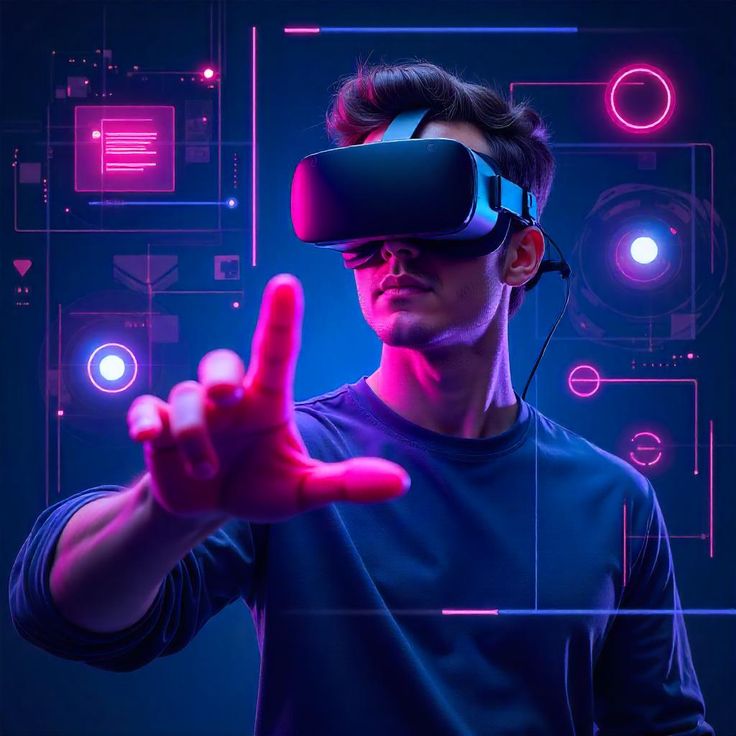
Augmented Reality (AR) and Virtual Reality (VR) are no longer limited to gaming and entertainment. These immersive technologies are reshaping the way businesses operate, engage customers, and deliver products and services. By blending digital content with the physical world or creating entirely virtual environments, AR and VR help organizations improve efficiency, enhance customer experiences, and unlock new revenue opportunities.
As digital transformation accelerates, companies across industries are investing in AR and VR solutions to stay competitive. From retail and healthcare to manufacturing, education, and real estate, these technologies are driving innovation and redefining traditional business models.
Understanding AR and VR
Although often mentioned together, AR and VR serve different purposes.
What Is Augmented Reality (AR)?
Augmented Reality overlays digital elements such as images, text, animations, or 3D objects onto the real-world environment through smartphones, tablets, or AR-enabled glasses. Instead of replacing reality, AR enhances it by providing interactive digital information in real time.
Examples of AR include:
- Virtual furniture placement in a room
- Interactive product demonstrations
- Navigation overlays
- AR shopping applications
- Industrial maintenance assistance
What Is Virtual Reality (VR)?
Virtual Reality creates a completely immersive digital environment that users experience through VR headsets and motion controllers. It allows users to interact with simulated environments for training, entertainment, education, and business applications.
Common VR applications include:
- Employee training
- Virtual meetings
- Product simulations
- Medical training
- Real estate tours
- Design visualization
Why Businesses Are Investing in AR and VR
Organizations are adopting immersive technologies because they offer measurable business benefits.
Key advantages include:
- Improved customer engagement
- Enhanced employee training
- Better product visualization
- Increased operational efficiency
- Reduced training costs
- Faster design and prototyping
- Stronger brand experiences
- Higher customer satisfaction
As hardware becomes more affordable and software more accessible, AR and VR adoption continues to grow across businesses of all sizes.
Business Applications Across Industries
Retail and E-Commerce
AR enables customers to visualize products before purchasing, reducing uncertainty and increasing confidence.
Businesses use AR for:
- Virtual clothing try-ons
- Furniture placement previews
- Cosmetic product testing
- Interactive product catalogs
- Personalized shopping experiences
VR enhances online shopping by creating immersive virtual stores where customers can browse products as if they were in a physical retail environment.
Healthcare
Healthcare organizations use AR and VR to improve patient care and medical education.
Applications include:
- Surgical planning
- Medical training simulations
- Rehabilitation programs
- Mental health therapy
- Pain management
- Anatomy visualization
Immersive technologies help healthcare professionals practice complex procedures in safe virtual environments while improving learning outcomes.
Manufacturing
Manufacturers leverage AR and VR to streamline production and maintenance processes.
Benefits include:
- Equipment maintenance guidance
- Factory planning
- Quality control
- Product prototyping
- Employee safety training
- Remote technical assistance
These applications reduce downtime, improve productivity, and minimize operational errors.
Real Estate
Real estate companies use VR to provide virtual property tours, allowing buyers to explore homes and commercial spaces remotely.
AR also helps clients visualize renovations, furniture layouts, and architectural designs before construction begins.
Education and Training
Educational institutions and businesses increasingly use immersive learning experiences.
AR and VR support:
- Interactive classrooms
- Virtual laboratories
- Skill-based training
- Technical simulations
- Language learning
- Corporate onboarding
These technologies improve engagement, knowledge retention, and practical skill development.
Marketing and Advertising
AR and VR create memorable marketing campaigns that strengthen customer engagement.
Businesses use immersive technologies for:
- Interactive advertisements
- Product demonstrations
- Brand storytelling
- Event experiences
- Virtual showrooms
- Experiential marketing campaigns
Immersive content encourages deeper customer interaction and increases brand recognition.
Enhancing Customer Experience
Customer experience has become one of the biggest competitive advantages for modern businesses.
AR and VR improve customer journeys by offering:
- Personalized product recommendations
- Interactive product demonstrations
- Virtual shopping experiences
- Faster purchase decisions
- Increased customer confidence
- Reduced product returns
These technologies help businesses create engaging and memorable experiences that build long-term customer loyalty.
Improving Employee Training
Traditional training methods often require significant time, resources, and physical materials.
VR provides realistic simulations that allow employees to:
- Practice high-risk procedures safely
- Learn technical skills
- Improve decision-making
- Experience emergency situations
- Build confidence before real-world tasks
AR supports workers by displaying real-time instructions and information during equipment maintenance or assembly tasks.
Product Design and Development
AR and VR accelerate product innovation by enabling teams to visualize, test, and refine concepts before manufacturing.
Advantages include:
- Faster prototyping
- Reduced development costs
- Improved collaboration
- Better design accuracy
- Early problem detection
Designers and engineers can evaluate products in immersive environments, leading to better decisions and shorter development cycles.
Challenges of AR and VR Adoption
Despite their benefits, businesses face several challenges when implementing AR and VR technologies.
Common obstacles include:
- High initial investment
- Hardware costs
- Software development complexity
- Integration with existing systems
- Data privacy concerns
- Limited technical expertise
- User adoption challenges
However, ongoing technological advancements and declining hardware costs are making these solutions more accessible.
Future Business Opportunities
The future of AR and VR is filled with exciting possibilities as technologies continue to mature.
Emerging trends include:
- AI-powered immersive experiences
- Mixed Reality (MR) applications
- Virtual collaboration platforms
- Smart glasses for workplaces
- Digital twins for manufacturing
- Virtual commerce
- Metaverse-based business solutions
- Remote technical support using AR
- Advanced healthcare simulations
Organizations that invest early in immersive technologies are better positioned to gain a competitive advantage.
Skills Needed for Careers in AR and VR
As demand grows, businesses seek professionals with expertise in immersive technologies.
Valuable skills include:
- 3D modeling and animation
- User Experience (UX) design
- User Interface (UI) design
- Programming with C#, C++, or JavaScript
- Game engine development using Unity or Unreal Engine
- Computer vision
- Artificial Intelligence integration
- Project management
- Creative problem-solving
- Communication and collaboration
Professionals with interdisciplinary skills will be well-equipped for careers in this rapidly evolving field.
Best Practices for Businesses
Organizations planning to adopt AR and VR should:
- Identify clear business objectives.
- Start with pilot projects.
- Focus on solving real customer or operational challenges.
- Invest in employee training.
- Choose scalable technology solutions.
- Measure performance using defined success metrics.
- Gather user feedback for continuous improvement.
- Stay updated with emerging industry trends.
A strategic approach helps maximize return on investment while minimizing implementation risks.
Conclusion
Augmented Reality and Virtual Reality are transforming the way businesses innovate, communicate, and compete in the digital economy. From improving customer experiences and employee training to accelerating product development and enhancing marketing strategies, these immersive technologies offer significant opportunities across industries. As hardware becomes more affordable and software capabilities continue to advance, AR and VR are expected to become essential tools for organizations seeking sustainable growth and competitive advantage. Businesses that embrace these technologies today will be better prepared to meet evolving customer expectations and lead the next generation of digital transformation.


